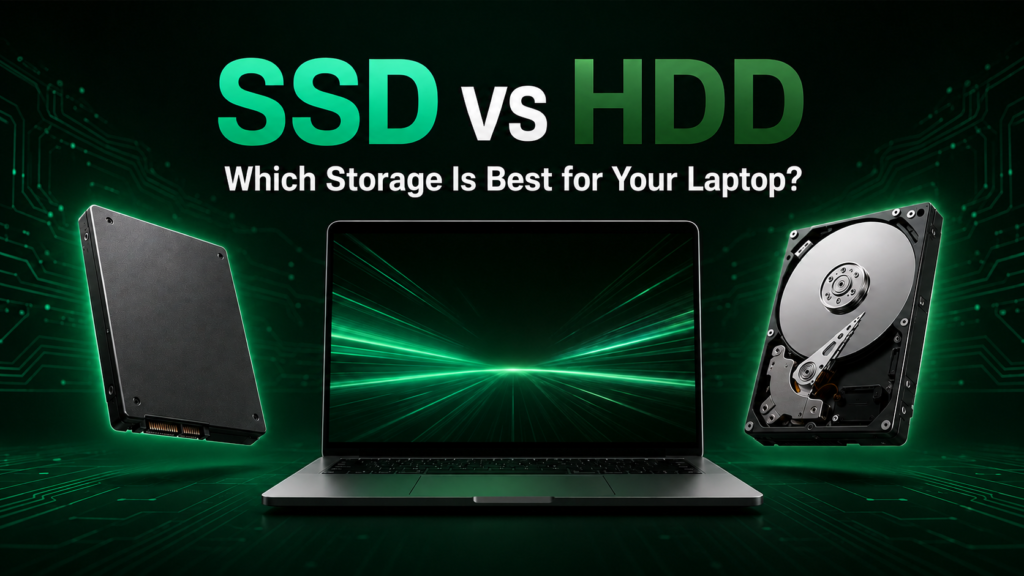
The type of storage installed in a laptop can significantly affect its speed, reliability, and overall performance. The two common options are a Solid-State Drive (SSD) and a Hard Disk Drive (HDD). Understanding their differences can help you choose the right laptop for work, education, business, or entertainment.
An SSD uses modern flash memory and provides faster startup, application loading, and file-transfer speeds. A laptop with a 256GB or 512GB SSD can start quickly and handle everyday tasks smoothly. SSDs are also quieter, lighter, more energy-efficient, and less vulnerable to physical damage because they do not contain moving parts.
An HDD normally provides more storage at a lower price and is suitable for keeping large collections of documents, photos, videos, and backup files. However, HDDs are slower than SSDs and can make a laptop take longer to start or open applications. For better performance and storage capacity, some laptops combine a fast SSD with a larger HDD.
Shreecom Africa offers laptops with different storage options for students, professionals, companies, and home users in Rwanda. Visit our website to compare laptop processors, RAM, SSD or HDD capacity, battery life, and other specifications. Our team can help you select a reliable laptop that meets your performance requirements and budget.